For the life of me, I don't know why more poetry readings don't incorporate more live music. Of course, I have little experience in organizing readings, and I've never collaborated with musicians, so I'm part of the problem. But I've just returned from an inspiring trip to Quinn Violins in Minneapolis, Minnesota.
Quinn Violins is more than just a music shop. The building includes studio space for musicians and some musicians offer classes there. Today's collaboration between poets and musicians featured the poets Ardie Medina, Michael Kiesow Moore, and Thomas R. Smith. They were joined by the Asiginaak Singers and cellist Lars Krogstad Ortiz.
In truth, more than collaboration was at play. Ardie Medina, in addition to reading her poetry, also sang with the two other members of the Asiginaak Singers. Robert Smith followed reading his own work by strapping a guitar over his shoulder and transforming himself into Jim Morrison and John Lennon.
But the highlight for me -- and I'm indebted to Michael Kiesow Moore for generously blurbing my chapbook -- was his collaboration with cellist Lars Krogstad Ortiz. Michael read, with Lars accompanying him on the cello with music that he must have composed with the poems in mind. The music added a degree of depth and texture that amplified the poetry rather than interfering with it.
It was perhaps the most entertaining and inspiring poetry events I've been to in long time.
The event took place in a small room lined with violins, appropriately enough. And isn't a rather poetically named music store -- Quinn Violins -- an appropriate setting for a musically infused poetry reading.
Sunday, November 5, 2017

Sunday, October 29, 2017
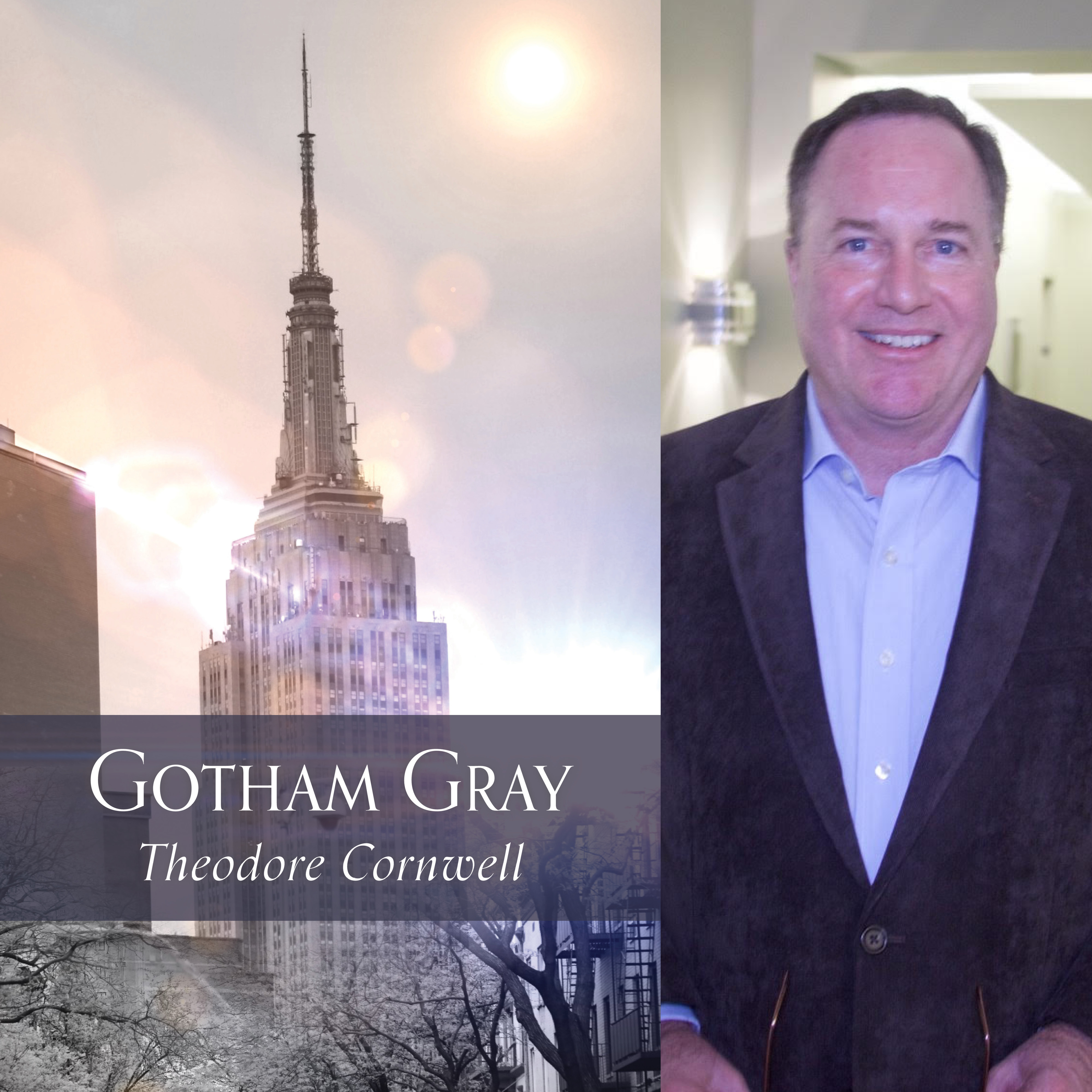
Gotham Gray is Out
As you can see below, my chapbook of poetry, Gotham Gray, has been published (thanks to Finishing Line Press for making that happen).
It's currently available from the Finishing Line Press website, Amazon, Barnes & Noble's website, and IndiBound, a website owned by independent bookstores that offers online book shopping.
By the way, in doing Web searches to find out just how easy it is to find my little book online, I discovered that there really is a paint color called Gotham Gray, though I can't remember which company makes it. At any rate, I'll check it out the next time I have a chance to remodel an apartment.
It's currently available from the Finishing Line Press website, Amazon, Barnes & Noble's website, and IndiBound, a website owned by independent bookstores that offers online book shopping.
By the way, in doing Web searches to find out just how easy it is to find my little book online, I discovered that there really is a paint color called Gotham Gray, though I can't remember which company makes it. At any rate, I'll check it out the next time I have a chance to remodel an apartment.
Saturday, June 17, 2017
A New Voice on Capitol Hill
Tracy K. Smith, pulitzer prize winning author of Life on Mars among other poetry collections, spoke with National Public Radio in an interview broadcast today about her appointment as Poetry Laureate of the U.S. (And, officially, consultant in poetry to the Library of Congress.) I remember living in D.C. in the mid-1990s, and readings or lectures featuring the poet laureate (I distinctly remember Rita Dove in particular) were always a highlight of D.C.'s literary calendar.
I was struck by somethings Smith said in her NPR interview about the role of poetry in a country facing times of division and dissension. Poetry is not just a vehicle to describe our own feelings, but also those of others -- serving as a vehicle to transport empathy. As such, she views poetry as something that becomes more essential in times of turmoil.
"The things that poems encourage us to acknowledge are more vital during times when we're up in arms about where we are going as a nation or where we're going as citizens," she told NPR.
I think Smith, whose work does not flinch from political and cultural hot spots, is an excellent choice for the laureateship. And I hope she will succeed in helping expand the audience of people who listen to poetry across the country.
I was struck by somethings Smith said in her NPR interview about the role of poetry in a country facing times of division and dissension. Poetry is not just a vehicle to describe our own feelings, but also those of others -- serving as a vehicle to transport empathy. As such, she views poetry as something that becomes more essential in times of turmoil.
"The things that poems encourage us to acknowledge are more vital during times when we're up in arms about where we are going as a nation or where we're going as citizens," she told NPR.
I think Smith, whose work does not flinch from political and cultural hot spots, is an excellent choice for the laureateship. And I hope she will succeed in helping expand the audience of people who listen to poetry across the country.
Monday, May 15, 2017
Stewart vs Trump
I have to admit, though I'm not a regular viewer of the late night talk shows, I enjoy Stephen Colbert more than any other late night host since, well, since David Letterman, whom Colbert replaced. And I was mostly a big Letterman fan during the early years of his career, when I was young and inclined to stay up late on a regular basis.
I happened upon the Colbert show last week on a day when he'd invited Jon Stewart, previously host of Comedy Central's daily show (which reminds me, I like Trevor Noah, the new host over there, quite a bit as well) and quite a few other veterans of the Daily Show -- Samantha Bee, etc -- onto the show to have a bit of a love fest for their former mentor. This all happened a few days after there had been some kerfuffle over an off color joke Colbert had made about Trump.
Though I'm not familiar with the joke, I'm sure I would consider it fair game, given all the crude and insulting things Trump has said about other people over the course of his campaign (and career). But Jon Stewart himself came to Colbert's defense rather eloquently, I thought.
"For the life of me, I don't understand why we hold comedians to a higher standard than we hold leaders to," Stewart said. "We can insult. He can injure," he said, referring presumably to Trump.
I happened upon the Colbert show last week on a day when he'd invited Jon Stewart, previously host of Comedy Central's daily show (which reminds me, I like Trevor Noah, the new host over there, quite a bit as well) and quite a few other veterans of the Daily Show -- Samantha Bee, etc -- onto the show to have a bit of a love fest for their former mentor. This all happened a few days after there had been some kerfuffle over an off color joke Colbert had made about Trump.
Though I'm not familiar with the joke, I'm sure I would consider it fair game, given all the crude and insulting things Trump has said about other people over the course of his campaign (and career). But Jon Stewart himself came to Colbert's defense rather eloquently, I thought.
"For the life of me, I don't understand why we hold comedians to a higher standard than we hold leaders to," Stewart said. "We can insult. He can injure," he said, referring presumably to Trump.
Saturday, May 13, 2017
An Amazing Gala
In a city full of galas and other black tie occasions, the National Sawdust gala stands out as something special. The evening's agenda isn't filled with speeches, exhortations and backslapping. Instead, music takes central stage and some of the best singers, musicians and composers working today keep the audience entertained during a marvelous dinner. Highlights (and there weren't any low points) including performances by Helga Davis (National Sawdust artist in residence), a new work by composer and NS artistic director Paola Pristini, and a closing performance by the band Gogol Bordello.
In addition to providing space and support for music composers, National Sawdust has hosted some compelling collaborations between musicians and writers, including the poet Roger Bonair-Agard.
Below is a photo of Gogol Bordello from the National Sawdust gala.

In addition to providing space and support for music composers, National Sawdust has hosted some compelling collaborations between musicians and writers, including the poet Roger Bonair-Agard.
Below is a photo of Gogol Bordello from the National Sawdust gala.

Thursday, May 4, 2017
The Book of the Dead
Speaking of poetry and resistance, the good people at Berl's poetry bookshop in Brooklyn marked May Day with a marathon reading (repeated throughout the afternoon) of Muriel Rukeyser's Book of the Dead, a sort of epic, narrative poem about a lung disease that plagued and killed miners at a West Virginia mine. The silicon particles that infested their lungs and claimed the lives of many workers is vividly described in Rukeyser's poem, which summons outrage on a scale that no journalistic account could muster, though clearly the poem is inspired by investigative accounts of the tragedy.
Though the audience was modest, (I was the only non-reader present during one reading) the event served as a reminder (to me at least) that poetry does make a difference in the world. Sure, many believe that poetry does not make anything happen, but the inspiration drawn from poetry surely can inspire us toward engagement of the kind that can make things happen in the world. A poem sparking outrage against an industrial disease and the governmental neglect toward the working people affected by the crisis seems a particularly fitting choice at this time, with Congress considering legislation to peel away health insurance coverage from potentially millions of low income, older and sick people.
Though the audience was modest, (I was the only non-reader present during one reading) the event served as a reminder (to me at least) that poetry does make a difference in the world. Sure, many believe that poetry does not make anything happen, but the inspiration drawn from poetry surely can inspire us toward engagement of the kind that can make things happen in the world. A poem sparking outrage against an industrial disease and the governmental neglect toward the working people affected by the crisis seems a particularly fitting choice at this time, with Congress considering legislation to peel away health insurance coverage from potentially millions of low income, older and sick people.
Subscribe to:
Posts (Atom)